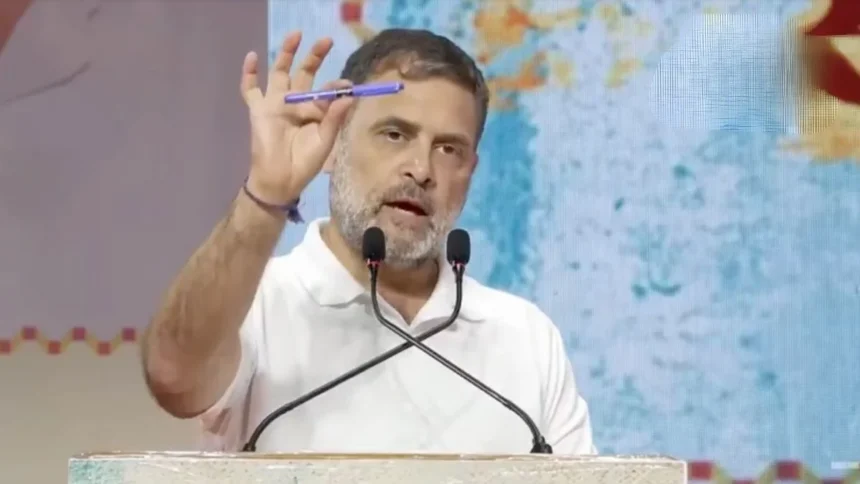

Rahul Gandhi’s Landmark Address at Lucknow’s Samvidhan Sammelan: Reclaiming Congress as the Poor Party in an Ambedkar-Gandhi Synthesis On March 13, 2026, in Lucknow, on the eve of Kanshi Ram Jayanti, Rahul Gandhi delivered what may well be remembered as a defining moment for the Congress party and India’s broader political discourse.
Addressing the Rashtriya Samvidhan Sammelan, he confronted the party’s historical blind spots on caste, repositioned the Constitution as the living culmination of centuries of resistance, and drew a sharp line between ideological politics and the money-driven machine of the BJP.
At its core was a provocative self-description: Congress must remain a ‘poor party with rich leaders.’ This was no rhetorical flourish. It was a strategic ontological reset.Gandhi openly acknowledged the ‘social churning’ rooted in caste-based discrimination and the long resistance against it.
He noted that Indian society remains starkly divided—roughly 15 per cent capturing the gains of power and wealth while the remaining 85 per cent, including Dalits, tribals, OBCs and the poor, are fragmented and excluded.
He pointed to private corporations, hospital leadership, and even MGNREGA beneficiary lists to illustrate how caste hierarchies persist beyond the state. Dalits, he observed, are largely absent from CEO suites and top professional roles; the labourers who build the nation’s infrastructure, however, overwhelmingly belong to these communities.
Crucially, he accepted Congress’s past inadequacy in treating caste as the central political question. ‘The path on which we were moving, we should have moved at a faster pace,’ he conceded. There had been ‘shortcomings.’
Yet he reframed the Constitution not as a 1947 document but as the consolidation of ‘thousands of years of Indian thought’ —the voices of Buddha, Mahatma Gandhi, Jyotirao Phule, Ambedkar and Kanshi Ram.
It is the Shramana tradition—ascetic, egalitarian, anti-hierarchical—made institutional. The Constitution, he held up, demands proportional representation according to population; it insists on equality that cuts across artificial boundaries of state, market, politics and institutions.
This brings us to the speech’s most radical assertion: Congress is, by design, a poor party. Its bank accounts may be frozen, its leaders individually wealthy, yet the organisation itself must reject the accumulation of institutional wealth. ‘This has been the design of the Congress since the time of Mahatma Gandhi,’ Gandhi declared. ‘If the party ever becomes rich, it would end up becoming like the BJP.’
The BJP, he argued, has perfected a model of alignment with entrenched corporate forces—exemplified by its alleged nexus with Gautam Adani—that generates the money to manage democratic and social faultlines. In that game of patronage and propaganda, Congress can never win.
The only viable battlefield is ideological: repudiating the very grammar of political money and its sources.Here the speech acquires deeper historical and philosophical resonance. It implicitly calls for the difficult but essential synchronisation of two towering yet divergent imperatives—those of B.R. Ambedkar and Mahatma Gandhi.
Ambedkar’s political imperatives were structural and uncompromising. He diagnosed caste not merely as social prejudice but as a political-economic order that required annihilation through law, representation and state power. Reservations, separate electorates (later compromised), the Directive Principles of State Policy, and the explicit constitutional commitment to equality, liberty and fraternity were his instruments.
For Ambedkar, democracy without social and economic democracy was a farce; power and wealth had to be redistributed irrespective of sacred or secular domains. Kanshi Ram carried this forward organisationally—building cadres, refusing compromise, and insisting that Bahujan power must translate into tangible control of the state apparatus.Gandhi’s methods and ontological imperatives, by contrast, were moral and existential.
Satyagraha, ahimsa, constructive programme, and the ethic of simple living were not tactics but expressions of truth (Satya) as the ground of being. Swaraj was inner self-rule before outer; trusteeship insisted that wealth is held in trust for society, not owned.
The party itself, in Gandhi’s vision, had to embody poverty—material simplicity allied with moral richness—to retain legitimacy among the masses. Compromise on principle was anathema; jail for years was preferable to dilution.The historical tension is well known. Ambedkar critiqued Gandhi’s reformist approach to caste (Harijan upliftment, idealised varna) as insufficiently radical.
Gandhi feared that Ambedkar’s confrontational politics might fracture the national movement. Yet Rahul Gandhi’s speech gestures toward their synthesis as the only viable path forward. Congress must adopt Ambedkar’s political instruments—caste census, proportional representation, aggressive inclusion of the marginalised across state and market—while retaining Gandhi’s ontological discipline: ideological purity, rejection of crony wealth, and non-compromising moral force.
This syncing is difficult precisely because it demands Congress shed its elite comfort zone and embrace both structural radicalism and ascetic organisational ethics. But it is essential. Without Ambedkar’s framework, Gandhian morality remains performative; without Gandhi’s moral grammar, Ambedkarite politics risks co-option into the very money-power nexus it seeks to dismantle.
The BJP’s model—alignment with entrenched capital to paper over faultlines—cannot be defeated on its own terrain. Only a party that repudiates that terrain entirely, remaining “poor” in resources but rich in ideological clarity, can initiate a new grammar.
Rahul Gandhi’s address does not claim instant transformation. It acknowledges past lapses and pays tribute to Kanshi Ram’s unyielding legacy (even suggesting Nehru would have made him a Congress chief minister). But its signal is unmistakable: the Congress must now fight ideologically, constitutionally, and across every domain of power.
By owning its historical shortcomings, invoking the Shramana-Buddhist-Ambedkarite stream, and recommitting to poverty as principle, it positions itself as the vehicle for a genuine Bahujan-inclusive democracy.
Whether the party can internalise this vision—translating the poor-party ethic into organisational reality and the Ambedkar-Gandhi synthesis into policy—will determine if this Samvidhan Sammelan speech becomes a mere footnote or the beginning of a historic course correction. For now, it stands as a rare moment of intellectual honesty and strategic clarity in Indian politics.