
S. Vikram, Political Commentator
On the eve of April 9, the structural and the spontaneous are in collision
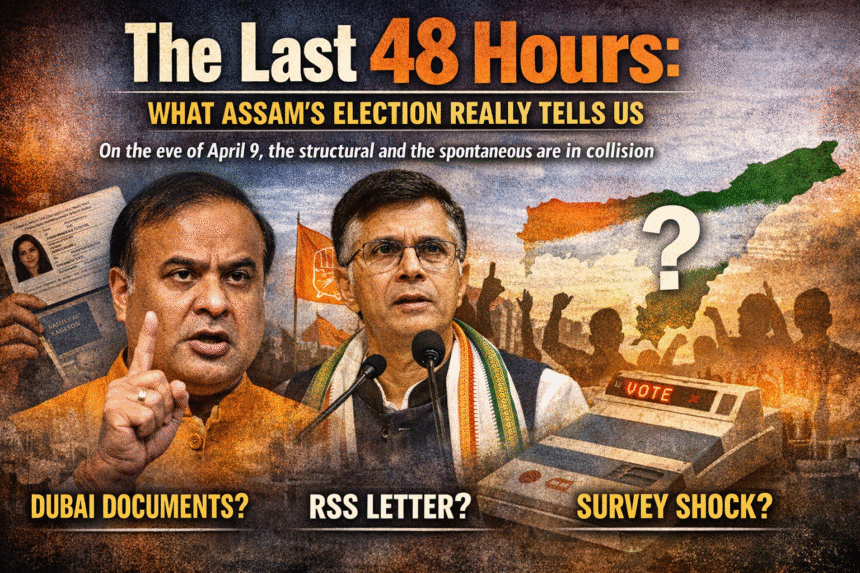
On the last full day of campaigning in Assam, two things happened simultaneously that, taken together, tell you almost everything about this election.
Pawan Khera held a press conference in Delhi presenting what he called documentary proof — passport copies, company incorporation certificates, Dubai property deeds — of a Chief Minister whose public identity is built entirely on being the sentinel of indigenous Assamese civilisation against Muslim encroachment.
And a letter, purportedly from local RSS leadership, continued to circulate on social media claiming the BJP would win no more than 35 seats.
The two events are connected. Both speak to the same underlying anxiety: that the edifice being presented to the public is more fragile than the architecture suggests.
The Arithmetic of a Manufactured Majority
Every national survey — Vote Vibe, IANS-Matrize, the aggregators of national media — projects the NDA winning between 87 and 97 seats with a 44 percent vote share, against the Congress-led bloc’s 36.7 percent. The Week These numbers, taken at face value, suggest a landslide. But there is a more interesting data point buried in the local research.
Peoples Pulse, a regional research organisation that conducted a ground-level tracker survey between November and December 2025, found only a 2 percent difference in vote share between BJP and Congress — 39 percent against 37 percent PEOPLES PULSE — even while projecting a BJP seat advantage of 69 to 74. That gap between the thinness of the vote margin and the width of the seat outcome is not an accident of survey methodology. It is the deliberate achievement of delimitation.
The delimitation of 2023, applicable for both the 2024 Lok Sabha and 2026 assembly elections, significantly redrawn political boundaries with the intention of consolidating the BJP’s position. The Barak Valley, for instance, saw its assembly seats reduced from 15 to 13. PEOPLES PULSE The exercise was not apolitical cartography. It was, as one cabinet minister reportedly told voters in a Muslim-majority constituency, gerrymandering so thorough that there was “no point for miyas to try and win.” The mathematical consequence is stark: a party can be beaten in popular support and still win decisively in seats. That is the floor the BJP has engineered.
The RSS Letter: Denial That Didn’t Quite Land
Against this backdrop, the letter matters — not because it is necessarily authentic, but because of the manner in which it was denied.
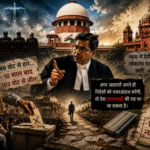
The RSS’s Guwahati Mahanagar Sanghchalak filed a complaint with the Cyber Cell describing the letter as a fake and AI-generated post being circulated to tarnish the organisation’s reputation. A separate complaint was filed in Delhi asserting the letter was “completely fake, untrue, and fabricated.” Organiser Weekly
Note what did not happen. No senior BJP leader held a press conference to laugh it off. No Himanta Biswa Sarma walked before the cameras to say: “The RSS thinks we will win 35 seats? We will win 100.” The denial came from the RSS’s own local unit and a private complainant filing a cyber cell complaint. Organisations that are genuinely untroubled by a piece of disinformation don’t typically respond with formal FIRs.
They ignore it, or they mock it publicly.
A number like 35 seats — which would represent a collapse from the current 60 BJP seats — if accurate as an internal assessment, would validate the core argument that the structural floor built by delimitation and SIR is the only thing holding an otherwise deteriorating position together. The silence of BJP’s political leadership on this letter is the loudest part of the story.
The Hypocrisy Trap
The Khera press conference was not primarily a corruption story, though it contained corruption allegations. It was a hypocrisy story, and that is a categorically different political weapon.
Corruption charges against the BJP have a well-established political immunity. The party has consistently governed on the premise that its ideological commitments — to Hindu identity, to indigenous protection, to hardline administration — render conventional accountability frameworks secondary.
Voters who share these ideological commitments have repeatedly demonstrated they will absorb corruption charges as the cost of doing political business with a party that “puts money where its mouth is” on identity.
But the allegation that Himanta Biswa Sarma’s wife holds passports from the UAE and Egypt — two Muslim-majority nations — while her husband has built his entire political identity on a civilisational war against Muslim “infiltrators” — this is not a corruption charge. This is a charge of bad faith at the most fundamental level. It says: the man asking you to sacrifice your Muslim neighbour’s citizenship rights has a family that has purchased citizenship in Muslim countries. The ideological project is the performance; the private arrangements are the reality.
Whether the documents are authentic will be determined in courts, eventually. But the political damage is not contingent on legal determination. It is contingent on the story lodging itself in the imagination of a specific kind of voter — one who already harbours doubts, who is already asking questions, who needed one more thing to tip the balance.
The Ahom Calculation and the Generation That Watches
Assam’s student and youth movement has historically been the hinge of political change in the state. It was not electoral arithmetic that drove the Assam Agitation; it was the moral force of a generation that decided a line had been crossed. That memory is encoded in the political culture of the state.
Today’s generation has its own Zubeen Garg. The singer was not a politician, but he was Assam’s emotional vocabulary — its pride, its pain, its complicated relationship with its own identity. Even within national surveys not designed to capture this sentiment, 42.6 percent of voters said Garg’s death would be a factor in the upcoming polls. The Week That is a remarkable number for something that is officially classified as an accidental drowning in Singapore.
The Vote Vibe survey found unemployment leading overall voter concerns at 25.6 percent, unevenly distributed across age and social groups. Opinions And Ratings Young Assamese voters are leaving the state for opportunity. They are watching a government that builds infrastructure but cannot build futures for them. They gave the government five and a half out of ten — not zero, not full marks. That ambivalence is the opening.
The Congress strategy in these final hours has been to fuse these emotional threads: Zubeen’s unresolved death, the hypocrisy of the passport allegations, the promise of justice. Rahul Gandhi explicitly invoked Zubeen as a symbol of the Congress philosophy — the unifier against the divider. It is a culturally intelligent pitch, even if the political machinery to convert it is uneven.
The Coalition That Might, and the Map That Won’t Let It
The theoretical coalition that could defeat the BJP in Assam is not implausible: 34 percent Muslim voters, 14 percent Ahom, a mobilised Gen Z, tribes still bleeding from Manipur’s wounds. The problem is not the arithmetic. The problem is the map.
Muslim voters, concentrated in Lower and Central Assam, form the backbone of the opposition’s base and could influence upwards of twenty constituencies. Organiser Weekly Twenty. In a 126-seat assembly where 64 constitute a majority. The rest of the coalition has to do the remaining work across terrain that has been specifically redrawn to prevent exactly this outcome.
The Ahom factor is the wildcard that no survey can reliably capture because it is ultimately a question of pride and its political expression. The BJP’s NDA secured 75 of 126 seats in 2021 Wikipedia with a coalition that included Ahom acquiescence to a non-Ahom Chief Minister — first a tribal, now a Brahmin. Gaurav Gogoi is Ahom. The contest in Jorhat, in Sibsagar, in the heartland of Upper Assam, is partly a referendum on whether that acquiescence has reached its limit.
What the Silence Tells Us
In politics, what is not said is frequently more revealing than what is. Himanta Biswa Sarma’s “48 hours” promise of defamation suits against Pawan Khera was announced on the last day of campaigning. The silence period begins. The votes are cast. The suits, if they come at all, will come after the verdict is known, robbed of all political consequence.
The RSS letter circulates. The denial comes from a local RSS official and a cyber cell complaint, not from the BJP’s war room. The number 35 sits in the information ecosystem, uncontested at the level where it would matter.
The national surveys say 87 to 97 seats. The local tracker says 2 percent separates the parties in vote share. The RSS letter says 35. Somewhere in the space between these three numbers is the truth that April 9 will reveal.
Assam has surprised before. It will surprise again, or it won’t. But the last 48 hours have told us something important: the confidence being projected publicly is not matched by the silence being maintained privately. And in politics, as in life, it is what people refuse to say loudly that most deserves our attention